

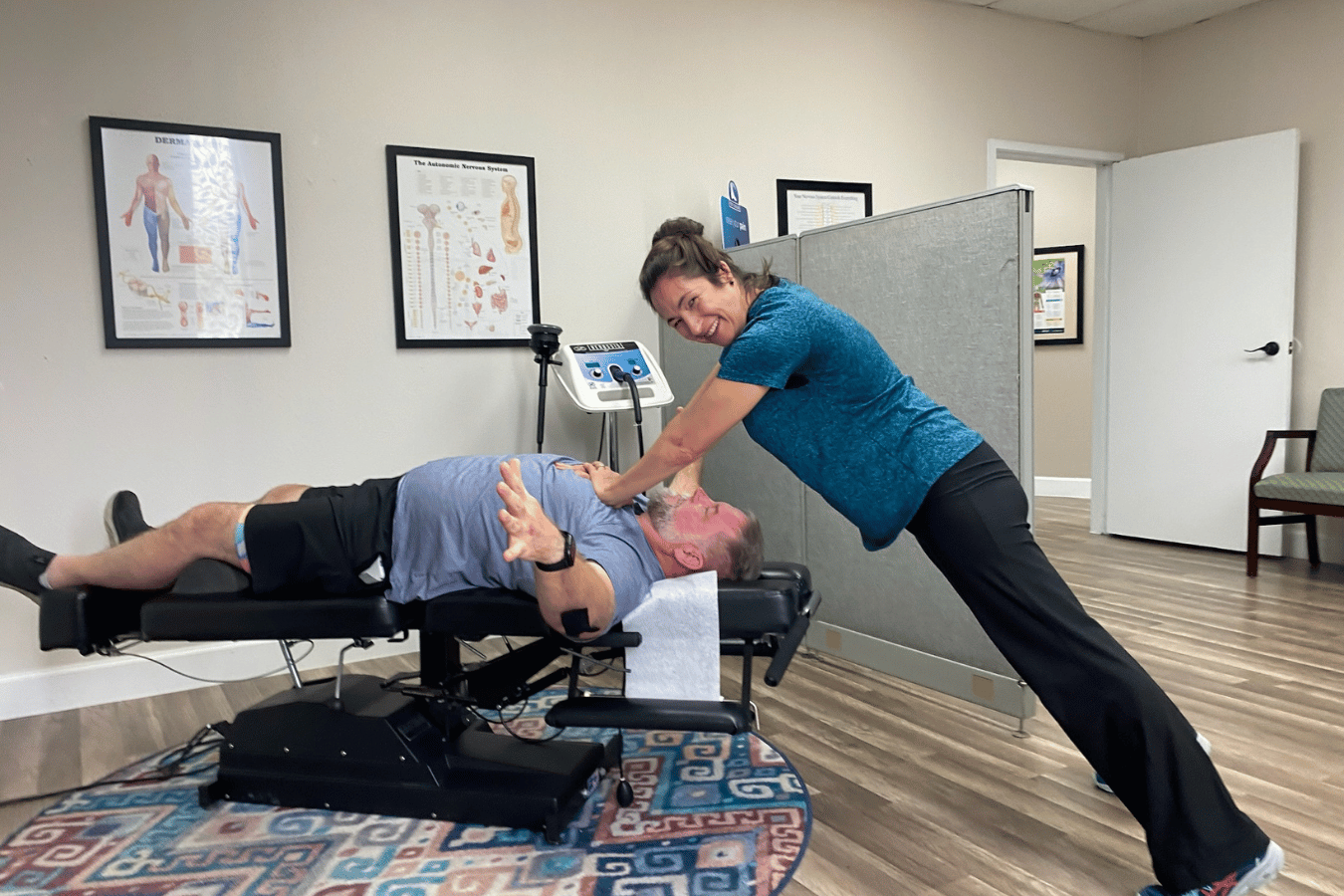
When your body moves better, you compete better, and small alignment changes can make a big difference.
Athletic performance is not only about training harder. It is also about how well your joints move, how efficiently your nervous system coordinates movement, and how quickly your body recovers between sessions. As a Chiropractor team in Pasadena, we work with active people who want to feel smoother, faster, and more resilient without relying on temporary fixes.
If you train consistently but keep running into the same tight hip, stubborn shoulder, or recurring low back irritation, there is usually a reason. Often, it is a mix of movement compensation, joint restriction, and soft tissue overload that builds up quietly until it shows up as pain, lost speed, or reduced confidence in your body.
In this guide, we will break down how chiropractic adjustments can support athletic performance, what we look for in an athlete’s evaluation, and how you can use care alongside training to reduce injury risk and keep momentum through the season.
Why spinal alignment matters for speed, power, and control
Most athletic movement is a full-body chain reaction. Your feet strike the ground, force travels through your ankles, knees, hips, and spine, and your nervous system coordinates timing so everything fires in sequence. When a joint is restricted or misaligned, you can still perform, but the body often takes a detour, recruiting the wrong muscles at the wrong time.
Chiropractic adjustments help restore normal joint motion, especially in the spine and pelvis where a lot of movement and stability demands overlap. When those areas move and stack properly, you can generate force with less wasted effort. Many athletes describe it as feeling more “connected” through their core, like the body is working as one unit again.
Alignment also affects how efficiently you breathe and brace. A stiff thoracic spine or rib restriction can limit expansion, which matters more than most people realize during intervals, heavy lifts, or long games in the Texas heat. Better mobility up top can support endurance and reduce the neck and shoulder tension that builds when you fatigue.
The nervous system piece most athletes overlook
A Chiropractor does not just think in terms of muscles and joints. We also think about the nervous system, because nerves are the communication lines that coordinate muscle firing, balance, and reflexes. When joints are not moving well, the body may receive “noisy” signals that change how you stabilize or load.
That matters in sports because timing is everything. A split-second delay in hip activation can turn a clean cut into a knee strain risk. A stiff mid-back can change shoulder mechanics and contribute to elbow or wrist overload. Adjustments aim to reduce that interference by improving joint motion and helping the body interpret movement more accurately.
Many people notice improvements in coordination and body awareness after care, especially when we pair adjustments with simple corrective exercises. It is not magic, it is just the body getting clearer information and using it to move with less compensation.
What we mean by “performance-based” chiropractic care
Performance care is not only about chasing pain. We often work with athletes who are not injured, but feel stuck. They are training, sleeping, eating well enough, and still not hitting the numbers they expect. In those cases, we look for limiting factors that hide in plain sight: asymmetry, restricted mobility, overactive tissues, and biomechanics that do not match the demands of your sport.
Our approach is holistic but practical. We use chiropractic adjustments, soft tissue strategies, and rehab-style movement work to help you move better and load better. The goal is to keep you on the field, in the gym, or on the trail with fewer interruptions.
We also pay attention to workload. A lot of overuse problems are not about weakness, they are about excessive loading on one tissue because another joint is not contributing. When we restore motion and distribute load more evenly, training tends to feel smoother and recovery often improves.
Common athletic issues we see in Pasadena and how adjustments help
In Pasadena, many athletes balance sports, lifting, and physically demanding jobs. That combination can be tough on the spine, hips, and shoulders. We see patterns that show up across sports, including in “weekend warrior” routines that spike intensity fast.
Here are a few problems we commonly address, along with the performance angle behind them:
• Low back tightness after squats or deadlifts, often tied to hip restriction or pelvic mechanics
• Neck and shoulder tension that affects overhead work, throwing, or contact sports
• Runner’s knee patterns that connect to hip control and ankle mobility
• Tennis elbow or forearm irritation driven by shoulder blade mechanics and repetitive loading
• Hip flexor and hamstring strains that follow asymmetrical movement and fatigue
• Ankle sprains that leave behind stiffness and change your gait long after swelling is gone
Chiropractic adjustments can help by restoring motion at key joints, especially when restrictions are forcing your body into compensations. When we combine that with soft tissue work and progressive rehab, athletes often regain confidence in how their body moves, not just how it feels.
Techniques we use to support performance and recovery
Most athletes benefit from more than one tool. Adjustments are central, but we often layer other techniques based on your sport, your history, and what your body is telling us that day. Some sessions are more mobility-focused, others are more tissue or stabilization focused, and that flexibility is important when training cycles change.
Our performance and recovery toolbox may include:
• Spinal and extremity adjustments to improve joint mechanics and mobility
• Soft tissue therapy to reduce muscle guarding and improve tissue quality
• Myofascial release for areas that feel “stuck” and limit movement patterns
• Kinesiology taping to support movement while you train and rebuild capacity
• Rehabilitation exercises to address imbalances and reinforce better mechanics
The point is not to pile on methods. The point is to pick what matters most for your performance goal, whether that is cutting faster, lifting with cleaner technique, or recovering quicker between practices.
How chiropractic care can reduce injury risk without slowing you down
Injury prevention is usually about consistency. When you move well, you practice and train more consistently, and that alone reduces risk. What gets athletes in trouble is the combination of restriction, fatigue, and high demand. A joint that does not move well forces other tissues to take the hit.
Adjustments can help maintain alignment and mobility so your movement options stay open. That matters in sport because you rarely get to move in perfect conditions. You land awkwardly, you rotate quickly, you absorb contact, you sprint when tired. Mobility and control become your safety margin.
We also look at muscular imbalances and tissue sensitivity. If your hips are rotating differently side-to-side, your spine might be compensating. If your ankle is stiff, your knee might be rotating to make up for it. These are small details, but over time they matter. Our goal is to address those root causes early, before they turn into missed games or modified training blocks.
What to expect from your first sports-focused visit
Seeing a Chiropractor for performance is a little different than a quick “crack and go” model. We want to understand how you train, what positions you play, where you feel limited, and what movements trigger problems. We also want to know what a good outcome looks like for you. A powerlifter’s goal is different than a soccer player’s, and both are different than a runner building mileage.
A typical first visit often includes a detailed history, movement assessment, and joint evaluation, followed by a care plan that matches your training reality. Many appointments run about 30 to 60 minutes depending on what we are addressing, and we keep the plan straightforward so you can follow it without turning your life into a rehab project.
A simple roadmap we use to improve performance
Athletes like clarity, so we keep our process easy to understand. While every care plan is personalized, most people follow a similar progression as we improve movement quality and reduce recurring flare-ups.
1. Assess what is limiting performance, including mobility, symmetry, and biomechanics
2. Restore joint motion with adjustments where restrictions are changing your movement
3. Reduce soft tissue overload so your body can accept training load more efficiently
4. Build stability and control with targeted exercises that match your sport demands
5. Maintain gains with periodic check-ins during high-volume training or competition
This is also where we make smart decisions about frequency. Some athletes need more visits early to calm down a stubborn issue, then transition into maintenance as training ramps up. Others come in periodically to stay ahead of flare-ups during a season.
Home habits that help your adjustments last longer
The best results usually come from what happens between visits. We do not expect perfection, but a few small habits can protect your progress, especially if you sit for work or drive a lot around Pasadena and the surrounding areas.
We often recommend a short daily routine built around mobility, posture checks, and light activation work. For example, five minutes of hip mobility, thoracic rotation, and gentle core bracing can help you keep the movement we restore in the office. If we use kinesiology taping, we will also show you how to use it strategically for training days without becoming dependent on it.
Hydration, sleep, and recovery days count too. When your nervous system is overloaded, tissues stay tight and movement quality drops. Good care supports performance, but your recovery habits decide how fast you adapt.
When you should consider seeing a Chiropractor for performance
Some athletes wait until pain forces a break. We prefer earlier signals, because that is when change is easiest. If your warm-up keeps getting longer, if one side always feels tighter, or if your numbers stall despite good training, it is worth an evaluation.
You should also consider care when you are returning from injury and want to rebuild confidence in movement. Even after pain fades, mechanics can remain altered. That is a common reason athletes feel “off” during a comeback, and it is also a time when re-injury risk can be higher.
If you are looking for a Chiropractor in Pasadena TX who understands athletic demands, we focus on keeping care practical, sport-relevant, and aligned with your goals.
Take the Next Step
If you want your training to translate into cleaner movement, faster recovery, and fewer setbacks, our team can help you build a plan that supports performance without adding unnecessary complexity. We keep the focus on biomechanics, nervous system function, and the specific demands your sport places on your body.
You can start with an athletic performance assessment and see how chiropractic adjustments, soft tissue work, and targeted exercises fit together at Champion Chiropractic of Pasadena. When you are ready, we will map out the next steps based on what your body needs now, not a one-size-fits-all schedule.
Join a community that values wellness, prevention, and recovery at Champion Chiropractic of Pasadena.